Kitchens
What a Range Hood Has to Move to Keep a Kitchen Livable
Range hood sizing runs on burner output, duct length and make-up air, not on the number printed on the box. Here is how the math works for a standard American range.
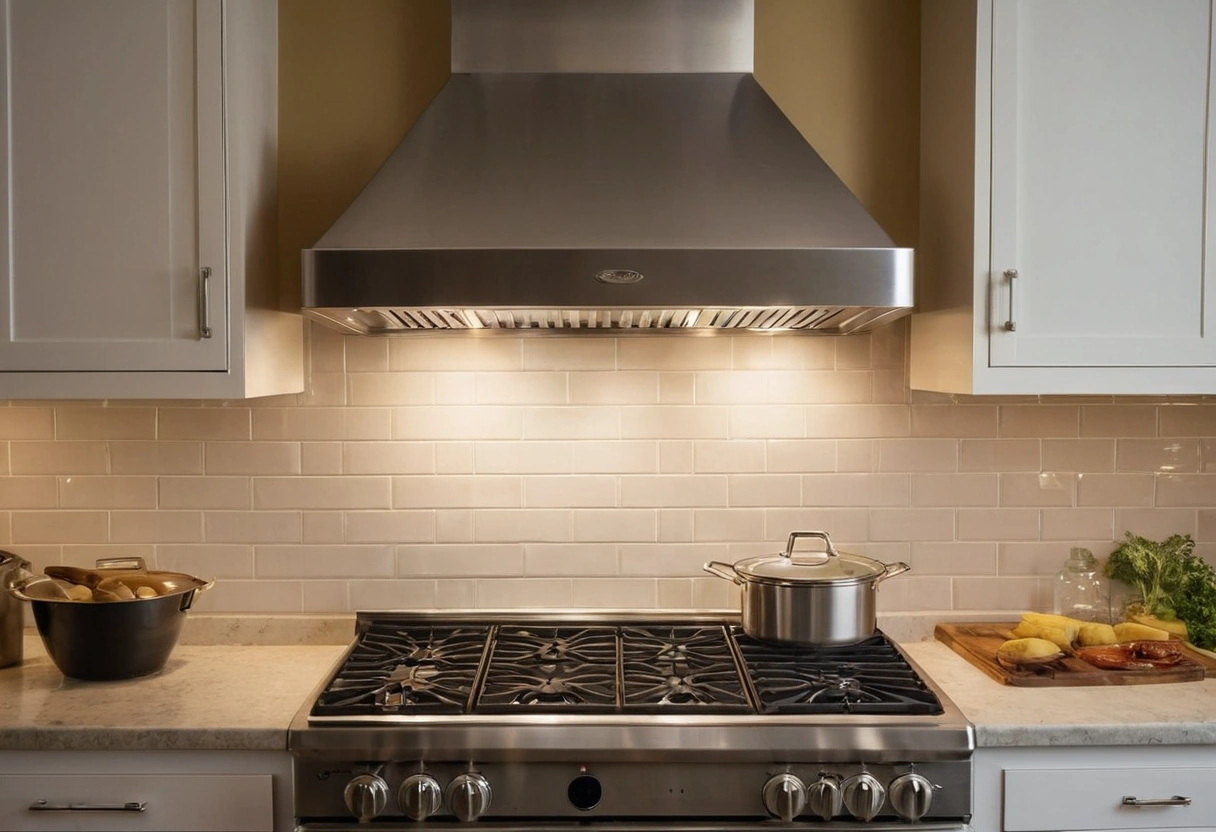
A range hood needs enough airflow to capture what the burners produce, a duct short enough to deliver that airflow, and make-up air once the fan moves more than 400 cubic feet per minute. A common sizing rule for gas ranges is 1 CFM for every 100 BTU of rated burner output, which puts a 60,000 BTU range near 600 CFM before duct losses.
The number on the box is the number the fan achieves on a test bench with no ductwork attached. The number in a house is lower, sometimes by half, and the gap comes from duct length, duct diameter, elbows and the roof or wall cap.
How many CFM does a range hood need?
Add the rated BTU of every burner, then divide by 100 for a gas range. A four-burner gas range rated at 45,000 BTU total suggests roughly 450 CFM. Electric and induction cooktops produce less convective plume, and a common approach sizes them at 10 CFM per linear inch of cooktop, which puts a 30 inch induction unit near 300 CFM.
| Cooking surface | Typical rating | Starting target |
|---|---|---|
| 30 in electric or induction | Roughly 7 to 11 kW | 300 CFM |
| 30 in gas range | 40,000 to 50,000 BTU | 400 to 500 CFM |
| 36 in gas range | 55,000 to 65,000 BTU | 550 to 650 CFM |
| 48 in gas range with griddle | 75,000 to 100,000 BTU | 750 to 1,000 CFM |
Households that sear, wok-cook or fry regularly should size to the upper end. Households that mostly simmer and bake can size lower and run the fan longer, which moves the same volume of air with less noise.
How much does duct length cost in airflow?
Every foot of straight duct, every elbow and every termination cap adds resistance that the fan has to overcome. Manufacturers publish equivalent length values, and a single 90 degree elbow in 6 inch round duct commonly counts for the same resistance as 10 to 15 feet of straight run. Three elbows can therefore erase more capacity than the entire straight length of the run.
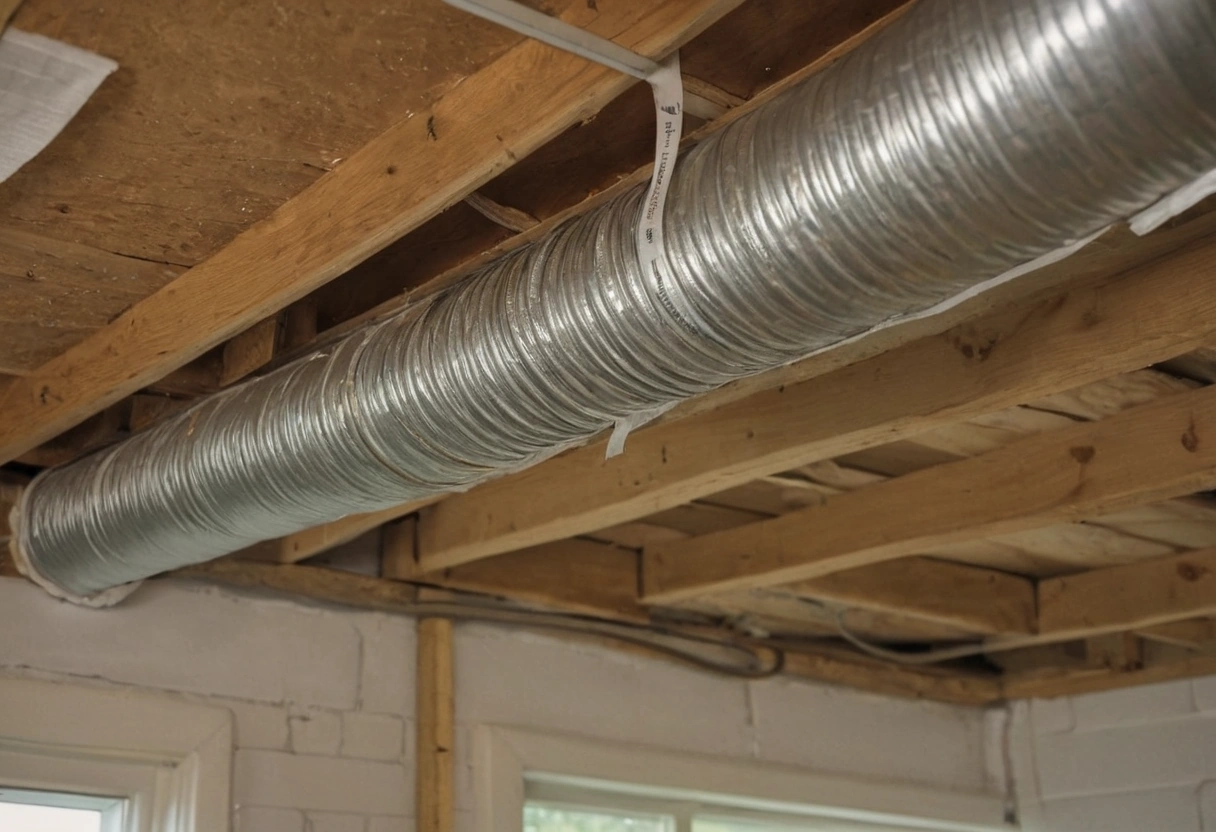
Two rules keep a real installation close to its rating. Use round metal duct at the diameter the manufacturer specifies, since 6 inch duct on a 600 CFM hood chokes it. Keep the total run under roughly 25 to 30 feet of equivalent length, counting elbows at their published values.
The rating on the box assumes no ductwork. The house is the ductwork.
When does a kitchen need make-up air?
Model residential code in the United States requires a make-up air path once a kitchen exhaust system moves more than 400 CFM, and many jurisdictions enforce it at permit review. Pulling 600 CFM out of a tight house without replacing it depressurizes the building, and a depressurized house pulls air backward down the nearest vent, which can include a water heater or fireplace flue.
Make-up air arrives through a dedicated duct with a damper that opens when the hood runs. In cold climates that duct usually needs tempering, because 20 degree outdoor air arriving at the kitchen floor is a comfort problem people solve by never turning the hood on. Budget the make-up air system at the same time as the hood, since retrofitting it after drywall costs several times more.
How high should a range hood be mounted?
Mount a wall hood 24 to 30 inches above a gas cooktop and 20 to 24 inches above an electric or induction cooktop, and confirm the range against the specific hood documentation. Mounting higher looks better in a photograph and captures less, because the plume spreads before it reaches the capture area.
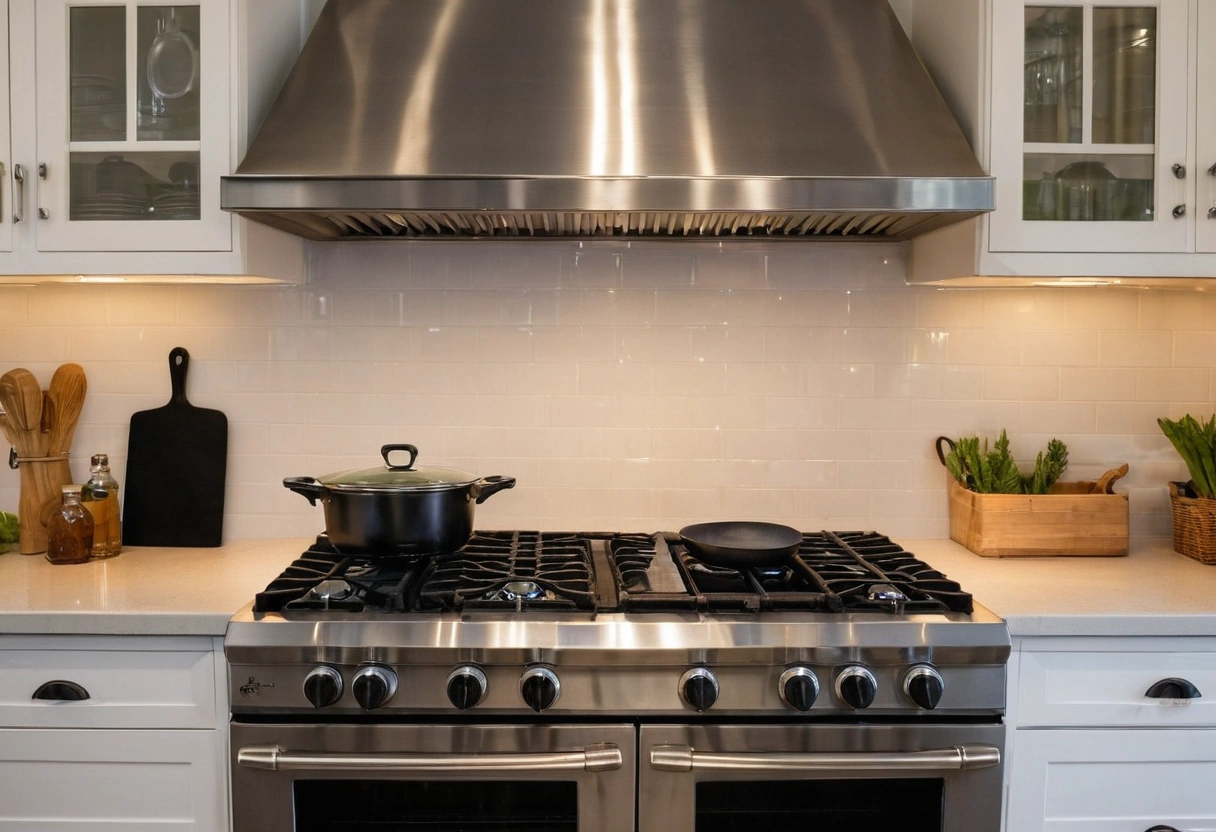
Hood width matters as much as height. A hood 3 inches wider than the cooktop on each side captures the plume that rolls off a large pan. A 30 inch hood over a 30 inch range works only when the mounting height sits at the low end of the range.
What about recirculating hoods?
A recirculating hood filters grease and returns air to the room. It removes odor partially through charcoal, and it removes no heat and no moisture at all. In an apartment or a condo where no exterior duct path exists, a recirculating hood is the available option, and it should be treated as a grease filter rather than as ventilation.
Moisture is the part people underestimate. Boiling a large pot releases considerable water vapor, and a recirculating hood sends all of it back into the kitchen. In a tight house that vapor lands on the coldest surface available, which is usually a window or an exterior wall corner.
What to specify before ordering
- Total burner BTU from the range spec sheet, not the marketing page.
- Duct diameter and material required by the hood manufacturer at the chosen CFM.
- The actual duct route with every elbow counted, drawn before framing.
- Whether the local jurisdiction enforces make-up air at 400 CFM, confirmed with the building department.
- Sone rating at the speed the household will actually use, since a hood too loud at working speed gets run at low speed and captures nothing, which matters more in an open plan kitchen.
A 400 CFM hood on a short straight duct outperforms a 900 CFM hood on a long duct with four elbows. The Uptown House suggests spending the budget on the duct route first and the hood body second.